Things You Should Know Before Constructing Portal Frame Warehouses
January 2, 2026
Things You Should Know Before Constructing Portal Frame Warehouses
If you are looking to build a commercial warehouse in the UK, you might want to consider creating a portal frame warehouse. It is a perfect set-up for use as a logistics hub or a light-industrial unit. Most people now favour portal frames for their clear spans, fast construction, and cost-effectiveness.
In this guide, you will know all about portal frame warehouses and how spans, haunches and bay spacing matter during their construction.
What is a Portal Frame?
Portal frames are a structural system generally used in low-rise structures, consisting of steel columns and pitched rafters connected rigidly to form a continuous structure. Unlike the traditional multi-column buildings, portal frames use moment-resisting joints that reduce the need for internal columns.
With a portal frame structure, you can develop large, unobstructed internal spaces, an efficient structure, and comply with modern cladding and roofing systems. In the UK, portal frames are so popular that approximately 50% of the steel used in construction is in portal frame construction.
Why Portal Frames are an Ideal Option for Warehouse Construction
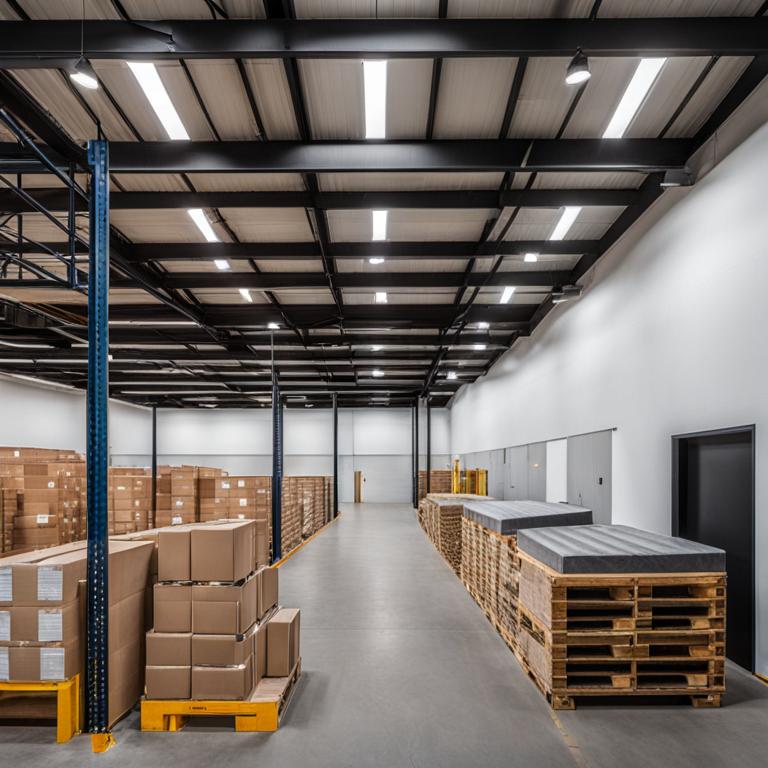
In warehouse construction, portal frames are used because they offer vast floor space, high eaves, and adaptable layouts. This is ideal for a warehouse facility where you can stack your business products on the racks and have enough space for forklift trucks to move freely on the floor.
If you want to use cranes inside the warehouse to move heavy products from one section to another inside the facility, you can install a beam overhead (supported by columns at both ends) to attach the crane hook to it. Moreover, the facility requires a simple foundation that supports a simple warehouse structure.
Now, let's take a look at different design elements in the portal frame warehouse.
Design Elements in Portal Frame Warehouses
Due to the unique design elements of portal frame warehouses, this warehouse structure has become a favourite option in the UK.
1. Clear Span
Span means the space between the columns of a portal frame warehouse. In the UK, these types of warehouses are designed to span about 15 to 40 meters. You can create your warehouse to meet your requirements.
With a large span, you can enjoy internal flexibility. Design the floor layout however you like. Besides, you can use the forklift truck without obstruction to movement. You can also install high-bay racking and integrate a mezzanine floor in the warehouse.
2. Haunches
Haunches are the deepened sections of steel located at the eaves of rigid portal frames. As the maximum bending moment occurs at the eaves of the portal frame, welding haunches at the eaves helps increase the rafter's bending resistance.
Haunches allow the frame to be rigid with an efficient bolted connection. In general, haunches are usually 10% of the frame span, and the depth of the rafter section should be equal to the depth of the haunches. Maintaining these technical details ensures the frame's safety and rigidity.
3. Bay Spacing
It is the distance between individual portal frames along the building's length. In the UK, typical bay spacing ranges from 6 to 8 meters. However, you may go for wider bay spacing depending on the installation of heavier sections. With correct bay spacing in the warehouse, you can optimise steel usage and align with dock doors, racking systems and structural grids. Make sure you appoint a skilled warehouse builder; otherwise, a poorly planned bay spacing may increase costs.
Reduced Construction Time
Businesses prefer building portal frame warehouses because of the speed of construction. Your builder can fabricate the steel frame off-site and install it quickly on-site. With a faster construction approach, portal-frame warehouses reach operational readiness faster.
Types of Steel Portal Frames
There are different types of steel portal frame designs available, depending on requirements, span dimensions, and architectural preferences.
Portal frames can be of the following types:
1. Single span
2. Multi-span with single portals
3. Multi-span with intermediate columns
4. Overhang
5. Adjoining
6. Single slope
In Summary..
Portal frame warehouse construction is now the go-to option for UK businesses. The main reasons are structural efficiency, speed of construction, and flexibility in warehouse layouts. If you know how the spans, haunches and bay spacing in the warehouse work, you can build a portal frame warehouse with absolute perfection.